As an Amazon Associate I earn from qualifying purchases. Click for details.
My New Orleans report – January 2006
Are there more ghosts in New Orleans after Hurricane Katrina?
I’m not sure if NOLA’s ghost population has increased, but evidence of ghosts certainly has.
My trip to Louisiana in late January 2006 was different from what I’d expected. It wasn’t my only visit to New Orleans after Katrina, but it was one of the most surprising.
I thought most of the city would be cleaned up by January. It wasn’t.
The French Quarter is a little quieter, but generally the same as always. More unexplained orbs in photos, and more psychic eeriness, but… well, it’s the French Quarter. Ghost hunters expect it to be haunted.
By contrast, the city of New Orleans was hit far harder than I’d anticipated, and the clean-up had barely begun.
METAIRIE CEMETERIES
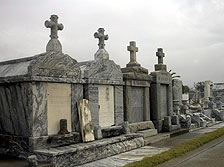 Driving in to New Orleans, there is evidence of wind and water damage, but it generally looks fairly normal from I-10. Once you get off the highway at Metairie, things change in a hurry.
Greenwood Cemetery — shown at right — looks the same as always, with minimal damage.
If I didn’t know that a hurricane and flooding had occurred there, I’d say that nothing was different.
Being very familiar with Greenwood, I saw only minor signs of damage, mostly slightly displaced headstones. The crypts were built to last, and so they did.
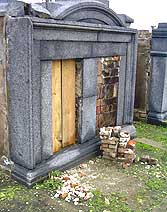
Nearby Cypress Grove Cemetery — shown at left — has always been a bit less tidy, and there’s far more evidence of flooding.
As seen in the photo, some of the brickwork on the crypts is being repaired. When I visited, three workmen were busy improving the cemetery.
Of course, I’ve always referred to Cypress Grove Cemetery in “Fall of the House of Usher” terms. It’s less tidy than Greenwood, and — in my opinion — it has a more personal character.
Generally, I like it there.
I’ve also seen odd, huge canine footprints in the mud at Cypress Grove, suggesting that something very unusual and perhaps paranormal — not a ghost — has walked there.
I’m not sure if the crypts at the Metairie cemeteries were responsible for the “floating coffins.” According to the concierge at one French Quarter hotel, tents were set up after Katrina’s waters receded. Coffins had floated loose, and were stored in tents, waiting to be identified and replaced in the cemeteries.
The tents are gone now, or at least moved away from public view. Except for the kind of obvious damage shown in my photo (above), there’s no way to guess how many graves had serious problems.
NEW ORLEANS’ NEIGHBORHOODS
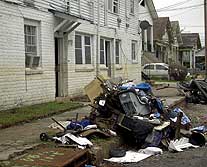 During late winter 2006, driving around New Orleans seemed positive apocalyptic. No electricity in many neighborhoods meant no traffic lights. Some streets were still covered with shards of glass… and whatever else was not scooped up by backhoes that cleared the rubble off the major roads.
If you want to see the massive devastation from the hurricane and its aftermath, take a tour bus from the French Quarter. (As I’m updating this article in early 2016, you can still tour areas left devastated by Katrina. Gray Lines is one of many excellent — and safe — ways to venture into those areas.)
In my photo (above, right), you can see one of the better (less damaged) homes.
Most buildings have a clear water line, inside and out. That’s not the highest level that the water reached, but where the water sat for the longest amount of time, after Hurricane Katrina.
These houses may look okay at first glance, but the wood has rotted. Many homes will have to be torn down and rebuilt. And, in other neighborhoods, all that’s left is rubble… massive piles of soggy wood, broken furniture, and mildewed belongings too black to identify. Oddly, the odor wasn’t too bad when I was there in 2006.
When I drove around in January 2006, I saw a frightening level of desperation among those left homeless. Whenever a Red Cross truck announced over a loudspeaker that they had free free meals and water, people stumbled out, as if from nowhere.
At the time, all I could think was “Night of the Living Dead.”
There will be active and residual energy hauntings throughout New Orleans for many years to come.
At this point, it’s too early to tell how severe the hauntings will be, but even during the daytime, there’s very eerie energy in these New Orleans neighborhoods.
By contrast, the French Quarter looked almost the same as it did before Katrina, with almost no damage. And, it is far more haunted than before. See my next article, French Quarter ghosts after Katrina