
As an Amazon Associate I earn from qualifying purchases. Click for details.
 Patterns emerge when I study profoundly haunted (or “active”) areas. They help me identify overlooked ghosts and paranormal phenomena.
In my book, The Ghosts of Austin, Texas, I described two major paranormal patterns connecting almost all hauntings in downtown Austin. With that information, ghost hunters can find dozens of unreported and overlooked Austin hauntings to investigate.
In haunted Salem, Massachusetts, different eerie patterns are emerging. I’m calling one of them “The Judges Line.” It seems to be a ley line.
Ley lines are lines or paths that connect sites with unusual energy. They could be major churches or temples, sites of violence and tragedy, or have some other unusual connection.
Some speculate that spiritual energy flows along those paths, and the energy was there even before the church was built or the violence occurred. In fact, that energy may magnify the emotions or affect the thinking of people when they are on or near a ley line.
As I map important sites related to the judicial side of the Salem Witch Trials, those sites closely follow a line. Oddly, that line also indicates where modern-day Salem judges have purchased homes. (The number of judges’ homes on the line is why I’m calling it “The Judges Line.”)
This line extends directly to haunted Gallows Hill Park, the most likely site of the hangings during the Salem Witch Trials.
If you’re looking for paranormal phenomena and eerie ghost stories, investigate sites along this line. Some of Salem’s most dramatic hauntings and fascinating paranormal activity occur within the yellow band on the map below.
Here is my preliminary, hand drawn map:
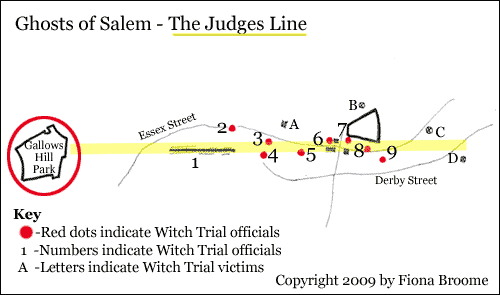
Here are my notes related to the numbers.
1. Chestnut Street (represented by a black line) – Many modern-day judges and elected officials choose this street for their homes.
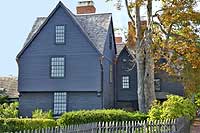
2. Judge Corwin’s home, also known as “Witch House” since he condemned so many witches during the Salem Witch Trials. It’s a prominent site in haunted Salem, and the house is open to the public.
3. Judge Hathorne’s home, also associated with the Salem Witch Trials. (Nathaniel Hawthorne changed the spelling of his own name to avoid any association with this ancestor.)
4. Sheriff George Corwin’s home – George Corwin was the son of the judge (#2) and benefited by seizing the property of convicted and admitted witches.
5. The home of Samuel Shattuck, a dyer whose testimony helped convict Bridget Bishop, one of the first Witch Trial victims.
6. The home of Massachusetts Bay Colony’s Governor Simon Bradstreet (1603 – 1697).
7. John Higginson Jr. lived here. He was the local magistrate. The Hawthorne Hotel was later built on this property. It’s one of haunted Salem’s favorite hotels; ask for a haunted room if you’re there to investigate.
8. Jacob Manning, a blacksmith, forged the shackles worn by many Witch Trial victims.
9. Thomas Beadle’s tavern, where Witch Trial inquests were held.
A. The home of Bridget Bishop, a Witch Trial victim who may be among the ghosts at the Lyceum Restaurant, now on that site. The Lyceum is a popular and delightful place to dine, and they’re happy to talk about their famous ghosts.
B. Ann Pudeator, a Witch Trial victim whose specter was seen walking along Salem Common, even before her execution. (I think this may be the location of the haunted Inn on Washington Square. If it’s not, her house was nearby.)
C. The home of John and Mary English, one of the wealthiest families in Colonial Salem. They were accused but escaped to New York.
D. Alice Parker’s home, owned by John and Mary English. Ms. Parker was accused of witchcraft and put to death.
The slightly triangular area near sites 7 and B represents Salem Common.
Gallows Hill Park is indicated on the far left side of the map. The “Judges Line” — generally indicated in yellow — points directly to it.
Gallows Hill Park features a playground and soccer field, and some disputed history. It’s been the location of many Wiccan and Pagan circles and ritual events. And, it’s near the most likely location of the gallows where the Witch Trial victims were executed.
According to some records, many of the “witches” were also buried there, in shallow and unmarked graves.
The small green areas near sites 6, 7 and 8 represent sites with paranormal activity or they are scenes of violence in the 19th and 20th century… or both. These include the Remember Salem shop, where you can take one of Salem’s best ghost tours with the Salem Night Tour.
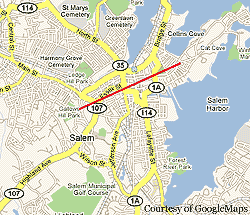
To get an idea of how narrow the Judges Line is, in relation to Salem in general, here’s a larger map. The Judges Line is indicated in red.
As I continue my research, I’m finding even more sites that will be represented with red dots. All of them are along the Judges Line.
That is the pattern that I mentioned during the February 28, 2009 show on Darkness Radio. (I was Dave Schrader‘s guest, along with friend and Salem Witch, Christian Day of Hex and the Festival of the Dead.)
In addition, a second pattern has emerged. It’s an odd connection among sites outside of Salem and within the city. As I applied that pattern to more recent history, I was able to predict where the Boston Strangler killed Evelyn Corbin, even before I confirmed the address with old newspaper records. So, it’s another chilling pattern.
Hi my name is Shawn and I worked at the Hawthorne Hotel in Salem,Ma for five years.I also worked at the Lyceum Bar and Grill for four years,believe me I never had any encounters at either place.I do believe and love the Paranormal,I just don’t have anyone brave enough to go exploring with me.I had a lot of paranormal activity at a house I lived at with my exwife and stepdaughter in Salem.We never told my stepdaughter that a old woman who lived on the first floor for 50 years passed away there a year prior.She used to wake in the middle of the night and tell us a old woman was standing over her watching her sleep.Bunch of other stuff too but I’ll be here forever typing with one finger.But back to Lyceum I would go upstairs in the Dark and sit for and hour or so after work and not once in four years saw or heard anything.Now Turner Hill Country Club in Ipswich that place is haunted for sure.We were having construction down and this little boy about 6yrs climbed up a two story ladder,this guy runs over tells the boy he needs too come down so he won’t get hurt,He says yesvI know the woman in the white dress upstairs told me too go down ladder so I won’t get hurt.Yes woman in white known to haunt up stairs.
Shawn I just read your note. I’m a ghost hunter here in Tulsa Oklahoma and like you never have anyone to go with. I have the equipment. My husband and I are coming to Salem this week and you know where to go. If you would be interested we would love to get together and see what we can find. It would be the highlight of my trip. Barbara Scott like me on Facebook its barbara Thomas scott