As an Amazon Associate I earn from qualifying purchases. Click for details.
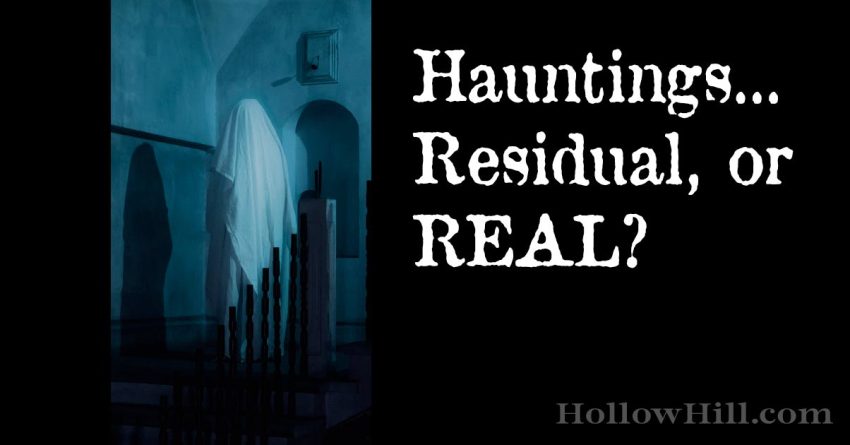
Sometimes, new ghost hunters ask me if specific hauntings are just residual or “real.”
Since at least 80% of hauntings seem to be residual energy, it’s important to recognize them. How “real” they are may vary with how much of an impact they have on visitors and investigators.
Let’s start with the terminology…
Residual energy
Emotionally charged events leave an imprint- or energy residue – on the physical objects nearby.
What distinguishes residual energy from an active haunting is that the activity repeats, as if on a loop. The energy levels may increase or decrease, but the content remains the same with each manifestation.
By contrast, in an active (or sentient) haunting, the ghost may respond to environmental stimuli and direct contact.
For example…
Residual energy hauntings usually appear the same, over and over again.
There may be an energy spike at a particular time of day, or on the anniversary of the event. (Those events can be happy — such as a birthday party or wedding — or tragic, such as the anniversary of a murder or a battle.)
In some cases, the haunting may draw energy from the investigators, slightly increasing the phenomena.
- If there’s EVP, the recordings will sound the same from one visit to the next.
- In photos, the manifestations will usually appear the same, as well. That is, the orbs will look alike and appear in the same locations.
Cookie-cutter predictability distinguishes sites with residual energy. Whatever is there, it never interacts with visitors.
But…
Active hauntings — that is, hauntings involving the spirits of people who’ve died — are more rare.
Those spirits may also visit at regular times of day or on specific dates. However, instead of acting in the same way each time, they respond to changes in the environment. They may interact with ghost researchers.
 In some cases, it can be tricky to tell the difference.
One of the best fictional examples is in the 1988 movie, High Spirits, Liam Neeson portrays the ghost of Martin Brogan.
At first, he seems to be a residual energy haunting.
-
- He repeats the same dialogue.
- His physical movements repeat as well, as he murders his wife again and again.
Then, Brogan is interrupted by an American tourist.
Right away, it’s clear that Brogan is an actual ghost.
The easiest way to tell the difference is to try to interact with it.
- Talk out loud to the apparent ghost.
- Ask it questions. Make comments.
- Stand next to it or block its path.
- In extreme cases, you can shout at it, to startle it a little. (That’s not the same thing as “provoking.”)
Your goal is to see if its behavior changes, and if it responds in any way to you and your team.
The ghost may reply.
- It may act angry.
- It may seem shy or frightened, and vanish.
- It may move objects, rap on walls or tables, slam doors, or roll a ball across the floor on command.
The point is: The ghost’s behavior changes with the people around it.
That’s what distinguishes it from residual energy.
Both active and residual energy hauntings are interesting to research.
Both can produce a wide range of phenomena.
So, are residual energy hauntings less real than active hauntings?
NO.
Both are equally ‘real’.
However, to achieve two-way communication with a spirit, you must be sure that an actual spirit is there.
You’re looking for variations.